
Who is this procedure for?
Facial lipofilling is for people with age-related volume loss, constitutional fat thinning, or localized hollows.
This indication often concerns the cheeks, temples, cheeks, nasolabial folds, the chin, or certain peri-orbital areas.
You must have a sufficient fat reserve in a donor area.
A health status compatible with surgical intervention remains necessary.
Certain medical situations may lead to adapting the indication or postponing it.
Consultation Process
The process begins with a specialized consultation dedicated to analyzing your face.
The assessment focuses on volumes, skin quality, symmetry, and your aesthetic expectations.
Medical photographs may be taken to document the project.
The donor areas and recipient areas are precisely defined.
A detailed quote and explanations of the aftercare are provided before any decision is made.
Preparation Steps, Necessary Examinations, Technical Choices
Preparation includes a pre-operative assessment in accordance with current recommendations.
An anesthesia consultation is scheduled when general anesthesia is considered.
The technical choice depends on the volumes to be restored, the areas treated, and your morphology.
Instructions concern the cessation of certain treatments, smoking management, and anticipating the aftercare.
Each step aims to ensure the safety of the procedure and optimize the expected outcome.
The Procedure in Practice
Anesthesia and Duration
Facial lipofilling can be performed under local anesthesia with sedation or under general anesthesia, depending on the extent of the procedure.
The operating time generally ranges between one and two hours, depending on the number of areas treated.
Technical Principles
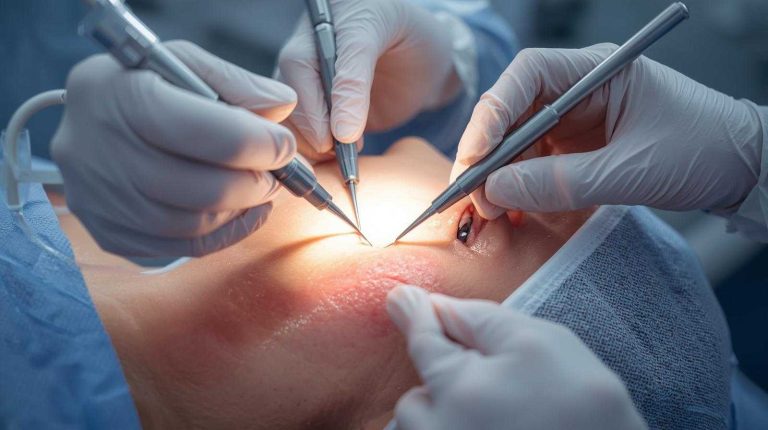
The first step involves fat harvesting using fine cannulas from a donor area.
The fat is then prepared and purified to select viable cells.
Reinjection is performed through successive micro-injections, ensuring homogeneous distribution.
This precise work determines the quality of the volume, the smoothness, and the durability of the result.
Post-operative Care
The aftercare frequently involves swelling and bruising in the treated areas.
A feeling of tightness or discomfort may occur during the first few days.
Care involves rigorous local hygiene and adherence to the provided instructions.
The resumption of social activities often occurs after one to two weeks.
The post-operative follow-up allows for monitoring the progress and assessing the stabilization of volumes.
Results and Scars
The result aims for a progressive restoration of volumes with a natural appearance.
Some of the injected fat may be reabsorbed in the first few months.
The stabilized result is usually appreciated between three and six months.
The scars from the harvesting remain discreet, often invisible from a distance.
Satisfaction depends on the initial indication, the technique used, and your individual response.
Risks and Possible Complications
Like any surgical procedure, lipofilling carries potential risks.
These include, in particular, infection, hematoma, volume irregularities, or excessive resorption.
Temporary asymmetries may appear during the healing phase.
Severe complications remain infrequent when indications are respected.
Complete information allows for an informed and realistic decision.
Fees and Coverage
Facial lipofilling generally falls under cosmetic surgery.
Coverage by Social Security does not apply in this context.
The fee depends on the areas treated, the volume required, the anesthesia, and the operative context.
Facial lipofilling starts from €5,500.
A personalized quote will be provided after consultation and analysis of your situation.