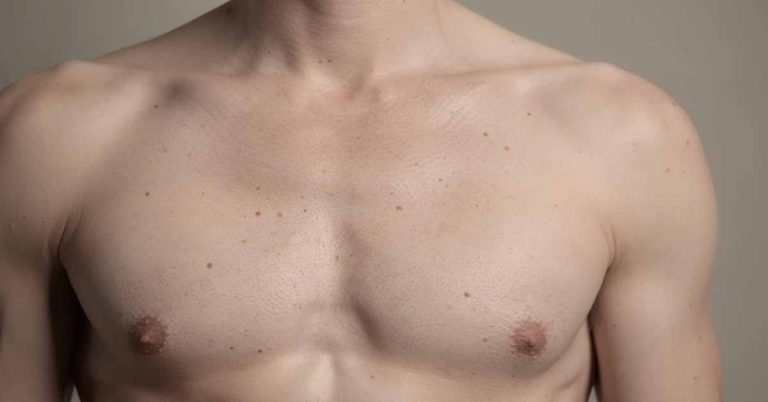

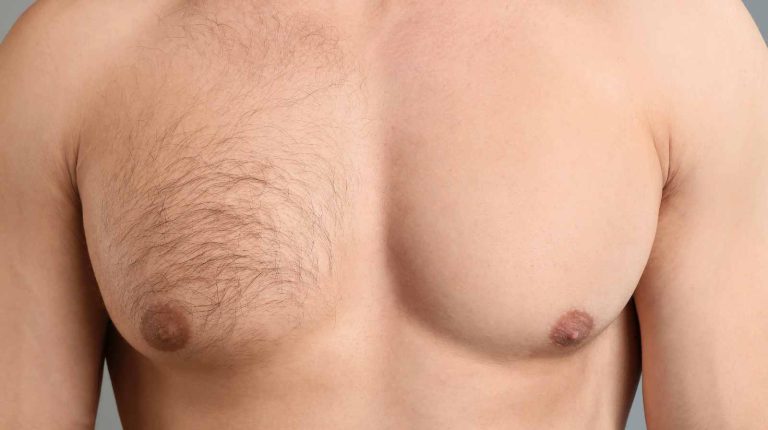
Definition and Causes of the Two Phenomena
Gynecomastia and adipomastia are routinely confused, yet they are two different conditions with two different treatments. One is an abnormal growth of the mammary gland; the other is an accumulation of fatty tissue over the pectoral muscle.
The confusion is understandable, since both change the shape of the male chest in the same direction. Underneath, the biological process differs entirely, and so does what can be done about it. Establishing the difference between gynecomastia and adipomastia is therefore the first step of any consultation.
What is Gynecomastia?
Gynecomastia is an abnormal breast development caused by proliferation of the mammary gland in men. It usually stems from a hormonal imbalance between oestrogen and testosterone. It appears frequently during adolescence and regresses on its own; when it appears later in life, an endocrine disorder, a medication or a liver disease is often behind it.
Growth of the gland creates a firm consistency around the areola, palpable as a disc under the nipple. That firmness alone separates it from adipomastia, which feels soft throughout. Understanding what gynecomastia is medically changes how the problem is approached.
How to Recognize Adipomastia?
Adipomastia, also called pseudo-gynecomastia, involves no glandular growth at all. It is localized excess fat in the pectoral region, and it typically affects men who are globally overweight or who store fat on the upper body.
Palpation finds no firm mass under the areola: the tissue is soft and diffuse from one edge to the other. The issue is aesthetic and only rarely linked to a hormonal disorder.
Clinical Examinations to Differentiate Adipomastia and Gynecomastia
A careful physical examination remains the first and most informative step in establishing the difference between gynecomastia and adipomastia. It often settles the question on its own. Where doubt persists, further examinations confirm the diagnosis and rule out other causes.
For patients who wish to go further or who are already considering an operation, surgical options exist, including gynecomastia surgery.
Here is what a physician relies on to tell a fatty tissue accumulation from a developed mammary gland.
Palpation Examination
The consultation begins with thorough palpation, patient lying down and then standing. A firm consistency around the areola points towards gynecomastia: the tissue feels like a dense disc just under the nipple, mobile against the deeper planes, and it is often tender to press.
In adipomastia no such core is found. The whole region feels uniform, soft and lax, with no change in consistency as the fingers approach the nipple. This tactile distinction guides the diagnosis more than any other single sign.
Additional Examinations
When doubt remains, a breast ultrasound settles it. Imaging distinguishes clearly between a thickened mammary gland (gynecomastia) and a simple fatty tissue accumulation (adipomastia).
A complete blood test may be added to look for a hormonal disturbance capable of explaining an abnormal breast development. It has no place where the picture is one of pure fat accumulation.
Difference Between Gynecomastia and Adipomastia: What are the Consequences and Solutions?
Naming the condition correctly determines the treatment. This is why the difference between gynecomastia and adipomastia carries weight, practically and psychologically.
Treatment follows both the diagnosis and the degree of discomfort the patient actually experiences. Establishing whether the problem is excess fat or mammary gland development therefore precedes any decision.
Management of Gynecomastia
Where there is a surplus of mammary gland, resolution generally means surgery. The procedure removes the glandular tissue responsible for the abnormal breast development, and often combines this with treatment of the overlying fat so that the chest contour stays smooth.
Gynecomastia can also reverse without surgery: stopping a causative medication, correcting a hormonal imbalance, or treating an underlying disease sometimes suffices. Any such approach is decided after specialised advice, otherwise recurrence is likely.
Management of Adipomastia
Where only a fatty tissue accumulation is present, the approach starts with lifestyle:
- reduction of daily caloric intake, adapted to each individual;
- regular physical activity, promoting pectoral muscle toning;
- sometimes resorting to liposuction to locally remove persistent excess fat.
With no enlarged mammary gland, there is nothing to remove surgically from that structure. Many men obtain a naturally masculine chest through diet and training alone, provided they give it enough time.
Various Factors That Can Exacerbate Confusion
Mixed forms are common. Some patients combine an increase in chest volume from a developed mammary gland with a genuine excess of fat, associating adipomastia and gynecomastia in the same chest.
Working out the respective share of each component matters, because it dictates the operative plan: glandular excision, liposuction, or both in the same session. A personalised assessment is what makes that call.
When to Consult a Specialist?
When in doubt, the opinion of a physician trained in male breast conditions is worth more than any online comparison. Rapid growth, pain, marked asymmetry or associated symptoms all call for prompt consultation to exclude a serious cause.
Anxiety on this subject is common and often disproportionate. A frank discussion with a competent doctor, backed by targeted examinations, usually resolves it.
Tips for Monitoring Evolution
Regular visual and tactile monitoring picks up any unusual change. Checking symmetry and firmness, and noting any pain or redness, takes very little time and gives real reassurance.
Examine yourself both standing and lying down: self-palpation in two positions is far more reliable than one, and needs nothing more than your own hand. That habit is what allows a change to be reported early rather than months later.